Personal Development Plans (PDPs)
Professional Development Plans (PDPs) or
Individual Development Plans (IDPs)
How to develop your own personal plan
Introduction to Personal Development Plans
What is Continuing Professional Development (CPD)?
Who is responsible for personal development?
What’s in it for me?
Learning Styles in personal development
Areas to include in your portfolio
On-The-Job Development Record – and other templates
Creating an individual personal development plan
Personal Development Plan forms
 Have a look at our ready to use training materials – leader guide, participant handouts, ppt slides etc
How to develop your own personal or professional development plan
As our employing organizations change, it is becoming increasingly important for us to develop our own plan and manage it to ensure our employability in these challenging times.
This page provides some of the tools to help you do that.
We have dozens of PDP style tools in our library and over the coming months they will be added to this page – please visit again soon.
The section below is a duplicate of a document produced and used with some of our clients. A printable PDF version is available in the downloads section.
Introduction to Personal Development Plans
All projects, large or small, holidays etc. benefit from proper planning and management.
The most important project you will ever be involved in is your own life.
Your career is a major part of your life and it therefore follows that you should properly plan and manage this aspect.
There is always a large element of opportunism in career development – the right person at the right time finding the right job. Although unpredictable elements exist, planning and personal initiatives can play a major part in creating opportunities for development and advancement. You should try to shape your career rather than simply react to events.
This may seem rather daunting and you may wonder where to start. This document has been produced to help you start this task and continue the journey to a successful career. It is easier than you think.
You should use this document in the way that suits you best.
A A4 ring binder with suitable dividing cards is suggested as a useful way of organizing your portfolio.
What is Continuing Professional Development (CPD)?
Continuing Professional Development is simply a method of ensuring that you achieve the right abilities to do your job and maintain/enhance your expertise. It embraces everything that you do to improve your job performance and your ‘lifelong employability’.
Many Professional Institutes and Societies have a requirement for their members to keep a record of their professional updating and development. It can also help those who are, or will be undertaking National Vocational Qualifications (NVQ’s) in the UK.
This is also good practice for an organization striving towards being ‘World Class’, a Learning Organisation.
Most of these professional societies have a requirement that you demonstrate personal development and learning representing 3-5 days (25-35 hours) per year.
Increasingly, your professional society is asking to see proof of continuous development in order to maintain your registration/ professional status. If your professional body does not yet have a mandatory requirement for this along with a monitoring/ auditing system they soon will have!
Who is responsible for personal development?
To be successful it is good practice to work in partnership with your employer. You should realize however that ownership of your CPD record is yours and no one else’s.
The plan you establish will need to be flexible and change as your job requirements and aspirations change. It should also be realistic, not everyone can become the Director of Nursing or Executive Director but everybody with foresight and some planning can find challenge, variety and interest in their job and career.
Change is continuous in all aspects of life and efforts you put into keeping abreast of new knowledge and expanding your abilities will reap rewards when opportunities arise.
It will have become clear that a key feature of CPD is training but the important difference between CPD and training is that CPD is structured to suit you and your career.
Note read Clinical for technical – and non-clinical for non technical |

It needs to be balanced between the clinical aspects and the non-clinical aspects (i.e. management skills, customer care, interpersonal skills etc.) and will often involve aspects that are not viewed as ‘training’ in its strictest sense, e.g. coaching, secondment, research, reading, agency work training others, Mentoring.
In fact many believe that the majority of our learning should come from experience and not the traditional training and qualifications.
Remember to balance short and long term needs as well as personal ones.
You do not have to meet targets made up of courses, in fact the collection of ‘points’ is increasingly discouraged. There are three keys to making CPD work and make learning more effective:
- Keep the record system as simple as possible, maybe your diary, a mind map, or a Personal Development Plan of some form.
- Start now with your current position, goals etc., the further you try to go back, the bigger the task looks and for most of us the more reason not to start in the first place!!
- Remember if you have it in print, use it, you do not need to duplicate it on a form. Keep It Short and Simple.
- Probably the most important point is to find a friend, mentor or coach who will give a friendly, or not so friendly nudge to keep you on track.
Note Attending a course and getting a certificate is not in itself CPD evidence, you should show learning and transfer. How you will or have used the learning. A one day course is not the same as 7 hours learning!!
top
|

Consider the analogy of walking up a downward escalator. As time goes by, your skills and knowledge with respect to current thinking and requirements diminishes. Therefore you need to maintain a certain amount of learning (CPD) to stay still. More to move up!
Even skills which 5 years ago were considered transferable are now being questioned. Communication skills, language skills, Project Management skills etc. are now seen by some as so situation specific that they are no longer considered core competencies!
Those of us who are employed within organizations that are regularly appraised, can use this to form a part of the planning of our CPD. Other activities which count towards our professional updating include: attending branch meetings, being involved in committees, reading and attending promotions, research, writing etc.
As we tend to learn most from our experience, this should form the bulk of our recorded CPD. For example, if we were to take the time to record what we learnt from new situations, or from when situations went especially well (or did not!!) this could help us not only to produce a learning log, but we should also increase our chances of actually taking that learning forward. All too often we think we have learnt a lesson, when in reality we do the same thing again at a later date.
CPD is not just about work and training for work, it is about life long learning. This means that activities like Parent Teacher Associations, school governors, residents groups, voluntary work, Young Enterprise etc. all count if you record them in the right way!
CPD recording, portfolios, learning logs etc. are not be an end in their own right, but a vehicle for planning, capturing and acknowledging real learning.
Learning Styles in personal development planning
Find your natural learning style and use learning methods which are more comfortable for you. This will not only make learning easier but it will also be more fun!
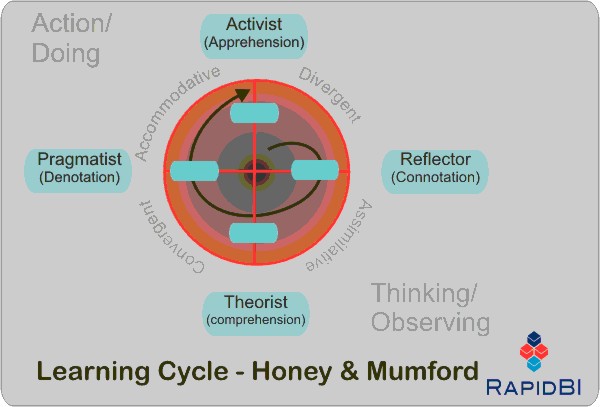
Here you can see the Honey and Mumford learning cycle. There is no correct starting point, but it is important to complete the cycle for sustained learning. Starting in the right place for you can make all the difference.
Your Training or Learning and Development Manager can help you identify this.
Areas to include in your PDP portfolio
Create an individual development plan
- Assessment of current skills and knowledge
- Planning your learning
- Recording Learning
- Evaluating Learning
What can I include in my personal development plan?
| Courses | Your objectives, what was learnt, how you will use the information |
| Mentoring | Dates, outcomes, key learning for you, how you will use the learning |
| Coaching | Dates, outcomes, key learning for you, how you will use the learning |
| Coaching – Informal | Outcomes of informal coaching with peers and other colleagues |
| Reading | What was learnt, how you will use the information |
| Research | Your objectives, what was learnt, how you will use the information |
| Training | The course objectives, what you learnt, what you will do differently next time. |
| Experiences | Real experiences from which you gained significant incite, Mistakes – yours or others. Record what happened, what you learnt, how you will have applied this. |
What is valid (for your profession)?
| Clinical/Technical – role specific | Yes – but if your role is only 50% clinical/ technical then only 50% of your updating should be clinical/ technical |
| Yes | |
| Business | Yes – but only to the level you are working at |
| Customer care/ service | Yes |
| Health and Safety | Only if your job has a health and safety responsibility |
When we get in the habit of planning and recording our learning on a regular basis our subconscious starts to look for learning opportunities for us in every day life. In other words if we do not know that a learning opportunity is available we do not react to it. The “Everywhere I look I see the same car” scenario when you have just bought a new car!
As parents we often say to our children “What did you learn at school today?” as adults we rarely ask ourselves or our partners “What did I/ you learn today?”
Change is happening at an increased rate if we wish to maintain our ‘Life Long employability’ our only advantage is our ability to learn faster (and smarter).
Making learning fun and interesting
As children we learnt while we played, it was both fun and easy. As adults we learn a great deal from our hobbies – things that we want to do and like doing. So if you want to make learning and training fun all you need to do is enjoy yourself and play!!!
Things to try for personal development planning
Keep a learning diary for a month
Make a point of discussing your learning with friends and colleagues
Other resources
- Your organizations’ training, learning and development programme
- Your Professional body’s meetings, committees, journal etc.
- The Internet, Web pages
- Local colleges, universities.
Low cost resources
- Product training from company representatives.
- Conferences – esp. the voluntary sector.
- TV – BBC The Learning Zone (night broadcasts).
- Promotions.
- Local libraries – they often have distance learning materials available for loan/low cost rent.
- National and Professional libraries.
Useful books include:
- Wake up Your Creative Genius – Hanks & Parry
- Through The Joy of Learning – NIACE
- Accelerated Learning – Rose
- Great Answers to Tough Interview Questions – Yate
- Use Your Head – Buzan
- The Mind Map Book – Buzan
- The Career Discovery Project – Sturman
- The One Minute Manager – Blanchard & Johnson
On-The-Job Development Record
For ___________________
On-The-Job Development Record Event: Date__________ What I learnt: What I will do differently in future is: |
On-The-Job Development Record Event: Date__________ What I learnt: What I will do differently in future is: |
Career History Template
| ||||
| Company/ Organization | Position Held | Achievements & what was learnt | From | To |
|
| ||||
|
| ||||
|
| ||||
|
| ||||
|
| ||||
|
| ||||
|
| ||||
|
| ||||
|
| ||||
|
Career Development Plan Template
| |||
| Career Development Aim | Planned Actions | Time Scale | Responsibility |
|
|
| ||
Personal Training Record Template
| ||
| Date | Activity/ Course | Key learning Points |
Notes
|
|
PDP Template
Creating Individual Personal Development Plans – PDPs
Below is a simple example to help you formulate your ideas for a personal development plan (PDP) or Individual Development Plan (IDP).
Objective: to identify what prior learning and experience can be accredited towards the achievements of the learning outcomes of an award and to process that accreditation.
| Developing a PDP | ||
| Your needs | How can you meet those needs? | How will you know when you have met those needs? |
| What are the challenges in my job current that I need to meet? | ||
| Where do I want to be in 2 years? | ||
| Where do I want to be in 5 or 10 years? | ||
| How does that fit in with what the practice wants? | ||
| What adjustments will I need to make to achieve what I want? | ||
| What adjustments will other people need to make for me to achieve what I want? | ||
| What else should I consider? | ||
| Record sheet to describe progress in work-based learning Record your discussions, action plan, resource requirements and the outcomes that you expect from your case study. Think how you will collect evidence that demonstrates you have achieved what you have planned. |
| Your priority topic:
|
| Your team includes:
|
Have a look at our ready to use training materials – leader guide, participant handouts, ppt slides etc
Keywords:
PDP, PDR, CPD, CPPD, RoA, IDP, Personal Development plans, Individual development plans, Personal Development Planner, continued personal development, continous professional development, life long learning, self development, record of achievement, portfolio, training record, learning log, training plan, individual learning plan, individual development plan, learning, templates, table, definition, samples, NHS, professional, professions
The Honey & Mumford Learning Cycle is © more details can be found about the LSQ at the Peter Honey web site.



 Loli says
19/07/2011 at 03:24Personal Development Plan – PDP’s Sample templates –
 Richard Bejah CFP® says
14/04/2011 at 22:14Personal Development PlansPDPs Professional Development PlansPDPs …: Most of these professional societies have…